Blog

Welcome to the Agentic Era: Google Cloud Next 2026 Recap

    Welcome to the Agentic Era. For organizations already deeply invested in Google Cloud Platform and Google Workspace, the experimental phase of artificial intelligence is firmly in the rearview mirror. At Google Cloud Next 2026 in Las Vegas, the narrative officially shifted from isolated generative AI chatbots to fully integrated, semi-autonomous “agentic systems” capable of running entire workflows.

    For technology leaders whose primary concerns are establishing ironclad security, optimizing cloud costs (FinOps), and streamlining complex cloud migrations, Next ’26 delivered a cohesive, highly actionable blueprint. Google is no longer just offering tools; it is providing the end-to-end connective tissue needed to deploy a digital taskforce securely and at scale. Here is a comprehensive deep dive into the most critical announcements across Gemini Enterprise, Google Workspace, and Google Cloud Security.

    Gemini Enterprise: The Engine for Agentic Operations

    Google is unifying its AI portfolio to help enterprises transition from simply answering prompts to delegating full business outcomes. Gemini Enterprise provides a single environment for teams to build, scale, govern, and optimize their AI agents.

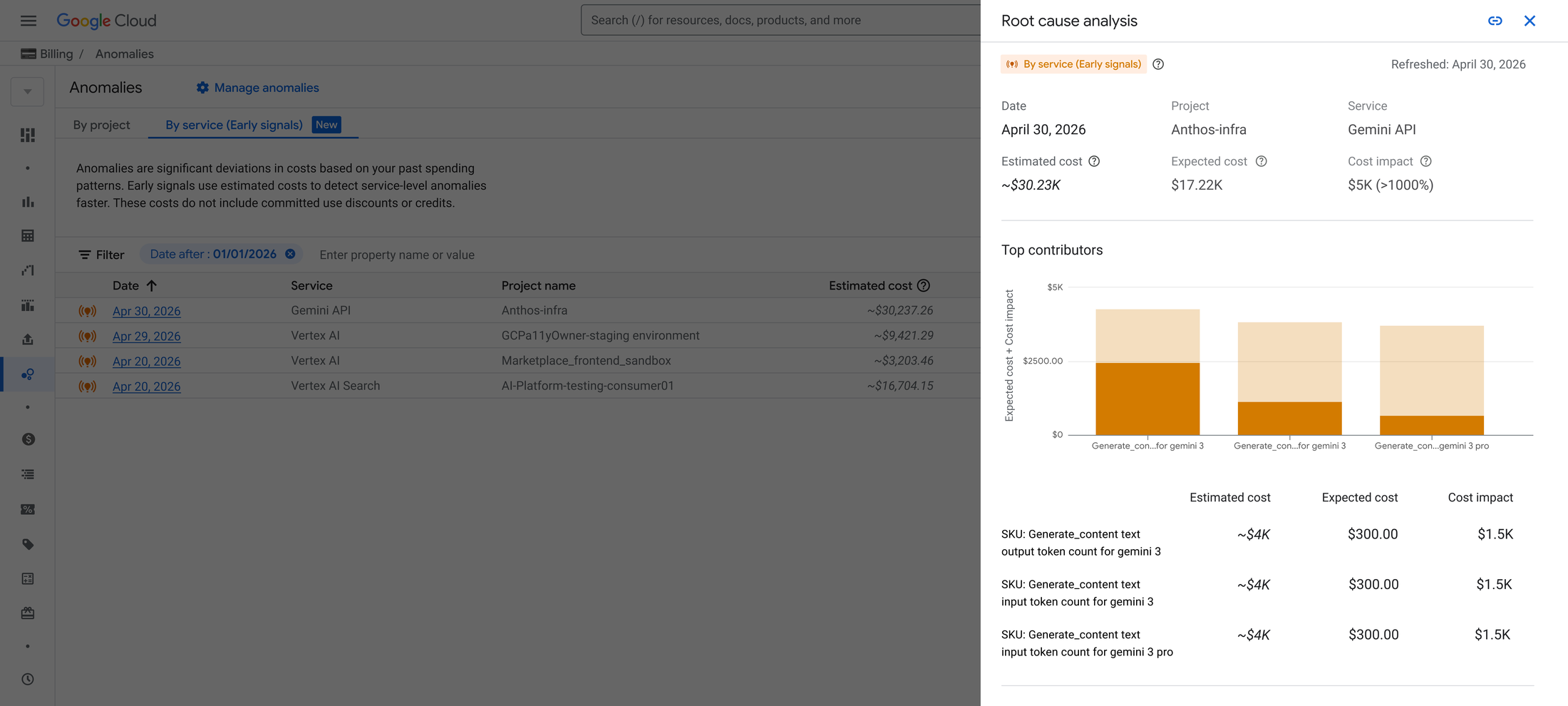
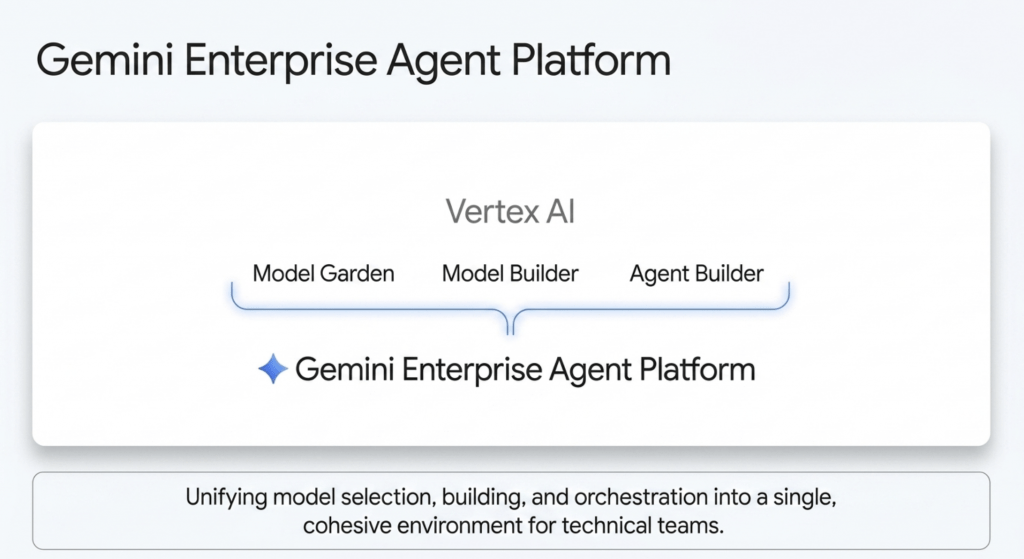
    Gemini Enterprise Agent Platform: Representing the evolution of Vertex AI, the Gemini Enterprise Agent Platform is the comprehensive foundation for technical teams. It combines the model selection and building capabilities that developers already rely on with powerful new features for orchestration, security, and DevOps. To directly address the growing need for strict FinOps and cost optimization, Google also introduced proactive cost anomalies detection. A new, dedicated FinOps agent autonomously analyzes spending spikes across your environment and generates highly granular cost reports on demand, ensuring your AI scaling doesn’t lead to unexpected budget overruns.

    Gemini Enterprise App: For the everyday workforce, the Gemini Enterprise App serves as the new collaborative “front door” to AI. It is designed to empower non-technical employees to build and manage their own digital assistants.

    • Agent Designer: This no-code visual builder allows business users to create sophisticated, multi-system workflows using simple natural language. Employees can now build agents that trigger automatically based on specific events or run on a set schedule without writing a single line of code.
    • Inbox in Gemini Enterprise: As employees deploy more long-running agents to handle tasks like financial reconciliation or sales sequencing, they need a way to track them. The new Inbox acts as a unified hub to monitor active workflows, adjust configurations, and receive real-time status alerts, ensuring automated processes always stay on track.
    • Projects: To solve the problem of context loss, Projects creates a persistent, data-grounded knowledge base for your team. It serves as a secure “shared brain” that grounds the AI strictly in explicitly added files and conversations. This ensures that critical project intelligence remains a permanent company asset, providing true operational continuity even as team members change roles.

    Gemini Enterprise for Customer Experience (CX) Designed to seamlessly unify the shopping and service journey, this suite ensures a frictionless customer experience from product discovery to post-sale support.

    • CX Agent Studio: A low-code visual builder that allows teams to design empathetic, highly multimodal agents grounded entirely in your enterprise data.
    • Omnichannel Gateway: This guarantees that a customer’s context travels flawlessly across web, mobile, voice, and social channels without any lag or repetition. The return on investment here is already proven; for example, Best Buy utilized these tools to increase their customer self-service rates by a staggering 200% by having agents engage in precise, long-format troubleshooting.

    Google Workspace: Reimagining Enterprise Productivity

    For the billions of users relying on Google Workspace, AI is transforming the suite from a collection of static applications into a dynamic, interconnected ecosystem.

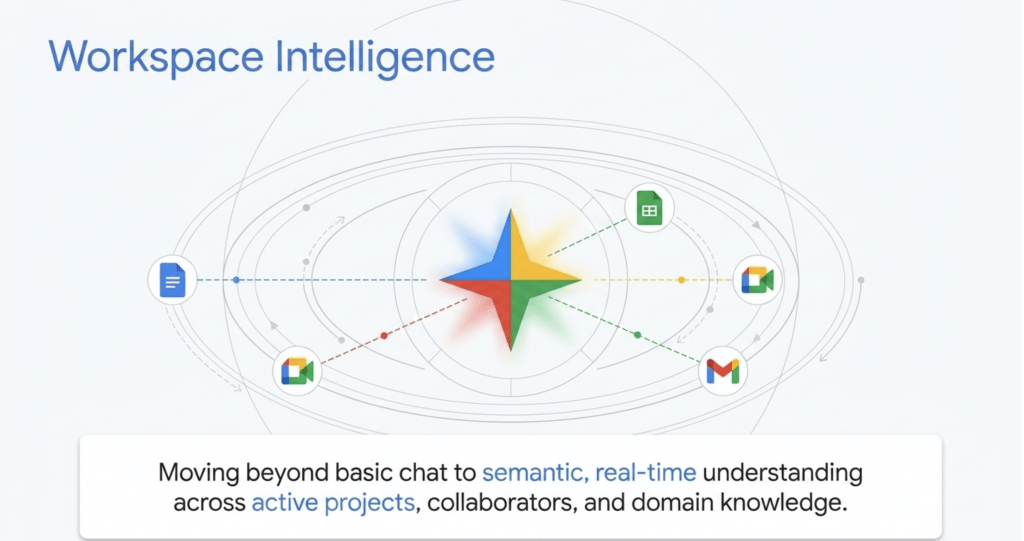
    Workspace Intelligence: The cornerstone of this transformation is Workspace Intelligence, a new, unified semantic layer. Instead of forcing users to manually copy and paste context into every single prompt, Workspace Intelligence inherently understands the complex relationships within your specific work ecosystem. It securely maps your active projects, your frequent collaborators, and the domain knowledge living across Docs, Slides, and Gmail. This allows the AI to do the heavy lifting of gathering context across silos, safely providing personalized, highly relevant outputs.

    New AI Features in Google Workspace

    • Ask Gemini in Google Chat: Your Chat window is now a unified command line for all of your work. It provides a daily briefing that surfaces important tasks and unread threads. Crucially, with expanded third-party connectors (like Asana, Jira, and Salesforce), Ask Gemini bridges the gap between your Workspace content and external tools, allowing you to find information across your entire tech stack without leaving the conversation.
    • Docs: Gemini can now automatically generate infographics, edit multiple images simultaneously, and automatically triage or edit documents based on user comments.
    • Slides: You can now generate full, editable presentation decks in one shot, with the AI strictly adhering to your company’s official templates and styles.
    • Sheets: A new Interactive Canvas allows you to use natural language to build interactive mini-apps—like kanban boards and custom dashboards—directly on top of your live data.
    • Drive: Drive Insights and Projects centrally organize files to give Gemini full context, allowing you to instantly extract insights across your entire drive using AI Overviews.
    • Vids: You can now quickly convert presentations into videos featuring highly realistic, fully branded AI avatars, complete with custom company logos and backdrops.
    • Workspace MCP Server: Currently in public preview, the Workspace Model Context Protocol (MCP) Server allows developers to safely bring advanced Workspace capabilities—like synthesizing Drive documents or drafting Gmail responses—directly into their own custom AI applications and agents using a secure, open framework.
    • Rapid Enterprise Migration: For organizations looking to move away from legacy tools, migrating your entire organization from Microsoft 365 to Google Workspace is now up to five times faster. This is powered by a new cloud-based data import service built directly into the admin console. To ensure there is no friction when collaborating with external partners still using Office, Google has also added improved interoperability features like an AI-powered Office macro converter, native Office file editing in Gmail, and redlining in Docs.

    Agentic Defense: Securing the Autonomous Frontier

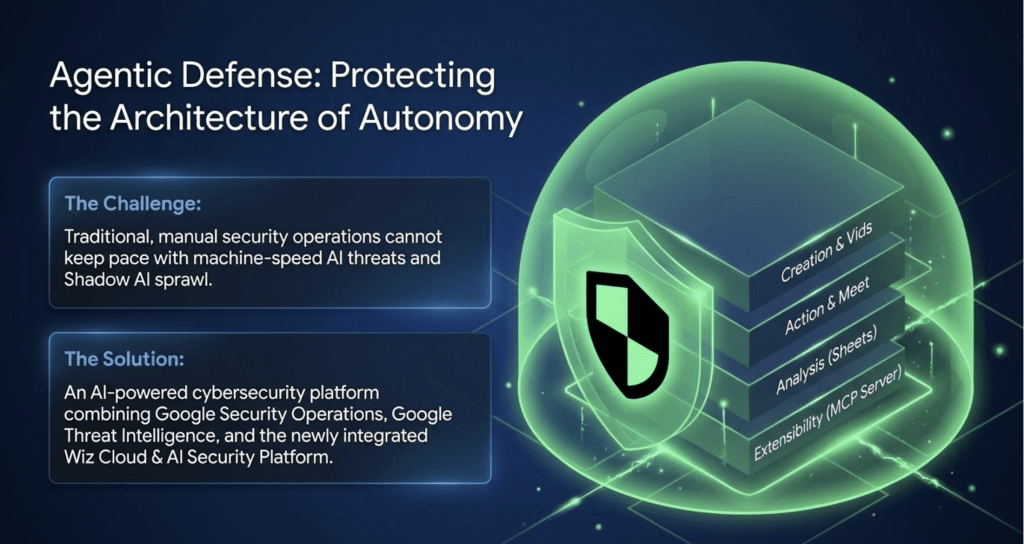
    As AI accelerates business operations, it simultaneously accelerates the speed of malicious actors. At Next ’26, Google revealed that adversaries have reduced the time it takes to move from initial access to a threat hand-off from eight hours down to a terrifying 22 seconds. To combat this, human defenders require AI that operates at machine speed.

    Wiz AI-Application Protection Following its deep integration into the Google Cloud ecosystem, Wiz introduced a comprehensive suite to secure the entire AI development lifecycle. A standout capability is the AI-Bill of Materials (AI-BOM). This dynamic tool automatically inventories all AI frameworks, language models, and IDE extensions across your multicloud environment. It provides absolute visibility into what is writing code in your stack, tracking sanctioned tools while aggressively uncovering and flagging unapproved “shadow AI” plugins. Furthermore, Wiz now offers inline security scanning that natively protects vibe-coded applications, surfacing vulnerabilities before they ever reach production.

    Securing Agents and the Agentic Web: To ensure that autonomous agents operate within strict, governed boundaries, Google introduced several foundational security layers. Agent Identity provides every digital worker with a unique cryptographic identity, allowing for precise, scoped human delegation and access management. Agent Gateway acts as a centralized air-traffic controller, enforcing strict security policies across all agent-to-agent and agent-to-tool communications. Finally, Model Armor integrates directly with Agent Gateway to provide robust runtime protection against emerging threats like prompt injections and sensitive data leakage.

    Agentic Threat Intelligence: To shift security from reactive to proactive, Google Security Operations introduced three new specialized, autonomous defenders.

    Google Cloud Fraud Defense: As commerce becomes increasingly automated, identifying who—or what—is interacting with your systems is paramount. In a major evolution of reCAPTCHA, Google launched Fraud Defense. This unified trust platform is explicitly engineered for the agentic web, capable of discerning the subtle differences between human users, malicious botnets, and authorized, helpful AI agents, effectively securing the digital journey from registration through to final payment.

    The Agentic Data Cloud: Fueling Autonomous Action

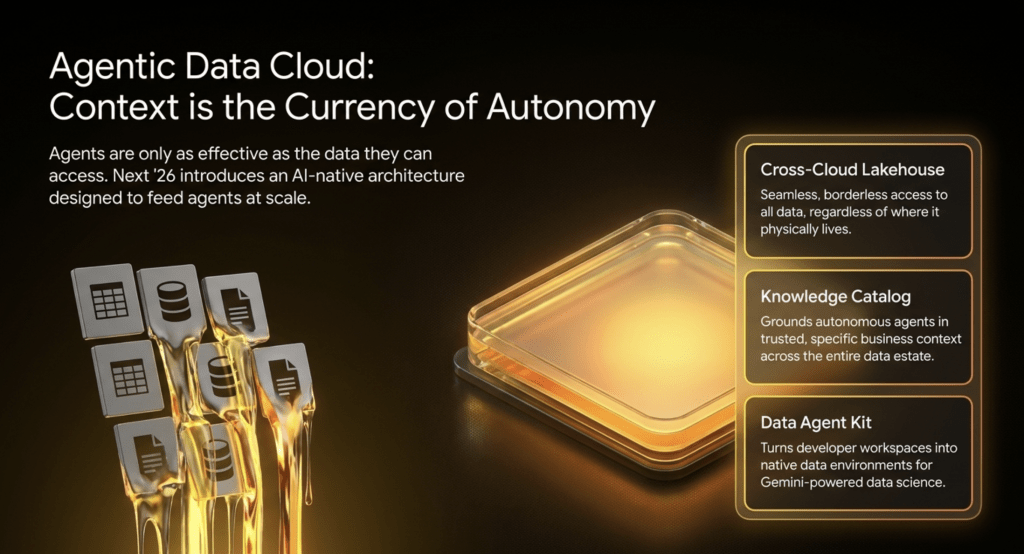
    In the agentic era, an AI agent is only as smart as the data it understands. Google’s Agentic Data Cloud unifies your operational databases, analytical lakehouses, and AI models so your digital taskforce is grounded in absolute enterprise truth—without causing cloud costs to spiral.

    Here are the core upgrades:

    • Knowledge Catalog (Governance): This replaces static data dictionaries with a dynamic, universal context engine. It autonomously maps your business logic and permissions without moving a single byte of data, ensuring agents execute tasks accurately based on your company’s unique lingo.
    • Cross-Cloud Lakehouse (Migration): Standardized on open Apache Iceberg, this allows you to instantly query data across Google Cloud, AWS, and Azure. It provides zero-copy, zero-ETL access, completely eliminating the latency and massive egress fees normally associated with cross-cloud data.
    • BigQuery Fluid Scaling (FinOps): Built for unpredictable agentic workloads, BigQuery now adapts dynamically with true per-second billing and zero minimums. This structural change delivers up to 34% in immediate cost savings for enterprise FinOps teams.
    • The Data Agent Kit: This shifts data engineering teams away from writing manual pipelines and toward agent orchestration. It turns any developer workspace into a native data environment to autonomously generate production-ready code.
    • Conversational BI with Looker: Looker introduces Dashboard Agents that allow everyday users to ask natural language questions directly within their dashboards, delivering answers that are strictly governed by your enterprise semantic layer.
    • AlloyDB AI at Massive Scale: To support the performance demands of enterprise AI, AlloyDB AI now scales to support over 10 billion vectors. It can process 100,000 rows per second for less than a tenth of a cent, bringing unprecedented cost-efficiency to operational databases.

    Conclusion

    Google Cloud Next 2026 proved that the infrastructure, intelligence, and security layers required for enterprise-grade AI are now fully integrated. By combining the unified context of Workspace Intelligence, the orchestration power of the Gemini Enterprise Agent Platform, and the machine-speed protection of Agentic Defense, Google Cloud has provided mature organizations with the exact tools they need to safely modernize their legacy systems, optimize their FinOps, and unleash the true ROI of artificial intelligence.

    Read article

    Why list your solution on Google Cloud Marketplace? A practical guide for product and go-to market-leaders

      Google Cloud Marketplace is more than a storefront. It is a procurement channel that helps buyers discover, evaluate, and purchase software with predictable billing and enterprise-grade procurement mechanics. For sellers, it can shorten buying cycles, increase deal size, and unlock co-selling opportunities inside the Google Cloud ecosystem.

      What makes Marketplace high value

      Marketplace simplifies procurement for enterprise buyers by connecting solutions to existing Google Cloud contracts and billing. That makes purchases easier and payments more predictable. Independent research shows that Marketplace often leads to longer, larger agreements for ISVs and partners while reducing procurement friction.

      The practical pieces every listing must get right

      A successful listing is a mix of technical, commercial, and operational readiness. Key requirements include validated architecture and security, a defined pricing and packaging model, seamless ordering and billing workflows, and end-to-end testing to meet Google standards. Failing any of these areas causes delays or rework during Google reviews.

      A concise Marketplace launch checklist

      1. Business readiness. Enroll in the Partner Advantage program, sign vendor agreements, and configure the payment profile and linked billing account.
      2. Technical integration. Enable Marketplace APIs, publish an architecture diagram, deploy a registration page and an order processing application, and implement usage reporting when needed.
      3. Pricing and packaging. Decide between subscriptions, usage-based models, or private offers, and document the billing flow.
      4. Test and validate. Perform test purchases and end-to-end acceptance tests with Google to confirm fulfillment and billing behave as expected.
      5. Launch and enablement. Publish the listing, support initial transactions, and coordinate go-to-market and co-selling motions.

      How to reduce time to revenue

      Because Marketplace is both technical and commercial, many teams benefit from a repeatable integration play. Native Marketplace workflows remove ongoing fulfillment overhead. Structured programs that combine architecture validation, order processing, testing, and GTM alignment make launches predictable and faster. Premier Cloud documents a multi-phase lifecycle that covers readiness, validation, integration, testing, and launch while providing hands-on engineering support for APIs, order processing, and test purchases.

      Premier Cloud also offers packaged professional services to accelerate onboarding and preserve engineering capacity. This makes it easier for product teams to focus on product while Marketplace specialists handle the integration and approval process.

      Bottom line

      Google Cloud Marketplace can be a high impact GTM channel when technical, commercial, and operational steps are coordinated. Use a clear checklist and consider a partner that knows the Marketplace lifecycle to reduce rework and get to transactions faster. If you want a practical plan to list your solution and manage fulfillment, Premier Cloud can help you move through readiness, integration, and launch.

      Read article

      Gemini Enterprise FAQ: Key Questions Businesses Ask Before Adopting It

        AI is everywhere right now, but most leaders are no longer asking whether it can write a paragraph. They are asking whether AI can safely support real work, connect to business systems, respect permissions, and meet compliance requirements.

        Gemini Enterprise is Google Cloud’s agentic AI platform built for that exact reality. Below are the five questions businesses keep asking, along with clear, practical answers.


        1) What is Gemini Enterprise?

        Gemini Enterprise is a secure, enterprise-focused AI platform designed to help employees search, analyze, synthesize, and automate workflows using Google’s Gemini models and agent technology. In October 2025, Google Agentspace became part of Gemini Enterprise, meaning the conversational AI and agent orchestration capabilities behind Agentspace now power core Gemini Enterprise functionality.

        Rather than existing as a standalone chat tool, Gemini Enterprise is positioned as an agentic layer across the business. Employees can investigate topics, summarize internal knowledge, and coordinate complex tasks using AI agents designed for enterprise workflows.

        2) How is Gemini Enterprise different from the Gemini app?

        This is one of the most common points of confusion.

        The Gemini app is built for general public use. Gemini Enterprise is built specifically for business and enterprise environments. It is designed to address challenges such as fragmented organizational data, cross-functional collaboration, and stricter security, privacy, and compliance requirements.

        In practice, Gemini Enterprise is meant to be the work version of Gemini. It connects to company systems and operates under enterprise governance rather than functioning as a consumer chatbot used at work.

        3) Who owns the data, and is any of it used to train models?

        For many organizations, this is the deciding question.

        With Gemini Enterprise Business, Standard, and Plus editions, customers retain full ownership of their data. Prompts, responses, and training data are not used to train Google models or models for other customers. Google does not sell customer data or use it for advertising.

        There is one important distinction. The Starter edition, which is an optional no-cost experience following the Gemini Business trial, may use data for product improvements and to train Google machine learning technologies. Customers can opt out of this behavior at any time through settings.

        4) What security and compliance controls does Gemini Enterprise support?

        Gemini Enterprise is designed for organizations that require governance and control.

        The platform supports enterprise-grade capabilities such as identity and access management, document-level permissions, audit logging, and customer-managed encryption keys. Certain editions also support data residency, allowing organizations to keep data within specific geographic regions. Gemini Enterprise aligns with major compliance standards such as HIPAA and FedRAMP.

        In addition, Gemini Enterprise includes built-in guardrails that screen AI prompts and responses for unsafe or malicious activity, including prompt injection and sensitive data exposure.

        5) What can employees actually do with Gemini Enterprise?

        Gemini Enterprise focuses on delivering value through both pre-built agents and customization.

        Out of the box, it includes Google-built agents designed for tasks like deep research, secure information synthesis, and AI-assisted software development. These agents help teams move faster without requiring custom setup.

        For organizations with more advanced needs, Gemini Enterprise allows teams to build and deploy their own agents or integrate existing ones. The platform also connects to common enterprise tools, including Google Workspace, Microsoft applications, and platforms such as Jira, Confluence, and ServiceNow. These connectors allow AI to work with business data while still enforcing existing access controls.


        The bottom line

        Gemini Enterprise is designed for organizations that want AI to move beyond experimentation and into everyday execution. By combining advanced AI reasoning with enterprise connectivity, strong security controls, and flexible agent capabilities, it provides a foundation for using AI responsibly inside real business workflows.

        Learn about what Premier Cloud has to offer around Gemini Enterprise.

        Read article

        What’s New to Google Workspace Series: 3 Practical Updates to Know About

          Google Workspace continues to roll out features that make everyday work a little easier. Here are three recent updates that offer practical improvements for communication, compliance, and file organization.

          1. Call Queuing for Google Voice

          Google Voice now supports call queuing for ring groups in the Standard and Premier editions. Incoming callers are placed in a queue instead of being sent to voicemail or disconnected. This helps teams handle high call volumes and reduce missed opportunities.
          Admins can set options like maximum wait time, queue size, and wrap-up time, making it easier for support and sales teams to stay responsive.


          2. Automated Compliance Recording for Google Meet

          Organizations in regulated industries can now use automated compliance recording in Google Meet. When a regulated user joins a meeting, the call is recorded and a transcript is saved automatically.
          Recording data is stored in a secure write-once, read-many Cloud Storage bucket to meet regulatory requirements in industries such as finance and healthcare. Participants will see a Compliance badge when this feature is active. This provides seamless compliance without disrupting the meeting experience.


          3. Smart Folder Insights in Gemini for Google Drive

          Gemini in Google Drive now shows instant folder insights right at the top of a folder. You can see a quick summary of what is inside, including document types, key themes, and recent updates.
          You can also select Explore with Gemini to get a deeper summary or ask questions about the folder contents. This helps users save time and stay organized, especially when working with large collections of files across multiple projects.


          Why These Updates Matter

          • Improved responsiveness with smarter call handling
          • Stronger compliance support for regulated industries
          • Faster information discovery with AI powered folder insights

          These updates help teams work more efficiently, stay compliant, and find information faster. If your organization needs in enabling and making the most of these features in your organization, contact us here.

          Read article

          Lee Henwood has been named a CRN 2025 Next-Gen Solution Provider

            We’re excited to announce that Lee Henwood, Premier Cloud’s Senior Sales Manager, has been recognized in CRN’s 2025 Next-Gen Solution Provider Profiles. This annual program highlights rising leaders across the IT channel who are already driving significant impact, and Lee’s work within our organization has been a major contributor to Premier Cloud’s continued growth.

            Strengthening Our Sales Organization

            In Lee’s role as Senior Sales Manager, they support Premier Cloud’s sales teams by providing strategic guidance, coaching, and day-to-day leadership that elevates performance across the board. Lee has been instrumental in refining our sales processes, improving operational efficiency, and ensuring our teams stay aligned with evolving customer needs in a rapidly shifting technology landscape.

            Lee’s leadership has helped our teams better articulate the value of emerging cloud and AI solutions, strengthening our ability to deliver modern, scalable technologies to organizations of all sizes.

            Driving Momentum in Cloud & AI Solutions

            A major area of Premier Cloud’s growth has come from supporting customers adopting Gemini Enterprise, Google’s advanced generative AI suite. Lee has played a key role in preparing our sales team to guide clients through these capabilities, helping them understand how Gemini Enterprise enhances productivity, supports decision-making, and integrates seamlessly into existing workflows.

            In addition, Lee continues to champion expanded use of Google Workspace and broader cloud solutions, ensuring our customers receive expert guidance on tools that improve collaboration, streamline operations, and harness AI-driven features.

            A Well-Earned Recognition

            Lee’s inclusion in CRN’s 2025 Next-Gen Solution Provider Profiles is a testament to his leadership, dedication, and forward-looking mindset that help drive our success. Join us in celebrating this achievement as we continue empowering our clients and shaping the future of cloud innovation.

            Read article

            Premier Cloud Celebrates Team Recognition in the 2025 Google Cloud Partner All-Stars

              Premier Cloud is excited to announce that three members of our team have been recognized in the 2025 Google Cloud Partner All-Stars program. This year’s honourees include Hirad Hajilou, Colin Jacques, and Alex Shahbazfar, each acknowledged for their outstanding contributions across Google Cloud’s sales and marketing categories.

              The Partner All-Stars program highlights top-performing individuals from across the global Google Cloud partner ecosystem. Each year, Google Cloud evaluates thousands of partner professionals and selects those who demonstrate exceptional achievements, impactful customer work and proven dedication to helping organizations succeed with Google Cloud technologies. The program recognizes talent across several key areas, celebrating those who consistently set a higher standard in their discipline.

              This recognition reflects the skill, dedication, and customer-first mindset that Hirad, Colin, and Alex bring to Premier Cloud. Their achievements represent the impact our team strives to deliver every day, helping clients modernize, innovate, and grow with Google Cloud.

              We look forward to continuing this momentum and supporting our customers with the same level of excellence recognized by the Google Cloud Partner All-Stars program.

              Read article

              Gemini Enterprise: How is it Different from Gemini in Workspace and NotebookLM?

                As organizations adopt generative AI, it’s common to encounter different tools that, at first glance, seem to overlap. A frequent question is how to distinguish between the AI features inside Google Workspace, the specialized tool NotebookLM, and the comprehensive platform, Gemini Enterprise. Each product is designed for a different purpose and operates at a different scale. Here is a clear breakdown of what each tool does.

                1. Gemini in Google Workspace

                This refers to the AI capabilities integrated directly into the Workspace applications you already use, such as Gmail, Docs, Sheets, and Meet.

                • Primary Goal: To assist with tasks within a specific application.
                • How it Works: It operates on the content you are currently working on. For example, it can help you draft or summarize an email in Gmail, write a blog post in Docs, create a project plan in Sheets, or generate images for a presentation in Slides.
                • Typical Use Case: You’re in a Google Doc and you ask Gemini to “help me write an outline for a marketing plan.” You are working on a single task within a single document.
                • Scope: Limited to the application you are in and the content it contains.

                2. NotebookLM (and NotebookLM Enterprise)

                NotebookLM is a standalone, AI-powered research and writing assistant.

                • Primary Goal: To help you understand, analyze, and synthesize information from a specific set of documents you provide.
                • How it Works: You upload your curated sources (like PDFs, Google Docs, website URLs, etc.) into a “notebook”. NotebookLM becomes an expert only on that information. You can ask it questions, and it will provide answers strictly confined to those sources, complete with citations.
                • Typical Use Case: A researcher uploads 20 clinical studies into a notebook and asks, “What are the common conclusions from these studies regarding treatment X?” It’s ideal for deep analysis of a known set of materials.
                • Scope: Limited to the specific, user-provided sources within a given notebook. The Enterprise version adds crucial security, compliance, and admin controls for business use.

                3. Gemini Enterprise

                Gemini Enterprise is a broad, advanced agentic platform that functions as a “new front door for AI in the workplace”. It operates at the scale of the entire organization.

                • Primary Goal: Enterprise-wide information discovery, multi-modal content generation, and—most importantly—the automation of complex, multi-step workflows.
                • How it Works:
                  • Connects to All Data: It securely connects to data across your entire organization, not just Google Workspace. This includes third-party applications like Microsoft 365, Salesforce, SAP, and databases.
                  • Builds AI Agents: It allows any user (not just developers) to use no-code tools to build custom “AI agents” that can orchestrate tasks across these different systems.
                  • Includes Other Tools: The Gemini Enterprise platform also includes NotebookLM Enterprise as one of its pre-built agents.
                • Typical Use Case: A finance manager uses the no-code workbench to build an agent that automatically: 1) pulls sales data from Salesforce, 2) cross-references it with expense reports from SAP, 3) analyzes the profit margin, and 4) generates a summary report every Friday.
                • Scope: Enterprise-wide. It’s designed to automate processes and find answers from all connected company data sources.

                Comparison at a Glance


                How Premier Cloud can help

                Understanding these distinctions is the first step. As a Google Premier Partner, Premier Cloud helps you move from theory to practice. We provide end-to-end services for Gemini Enterprise, starting with expert-led workshops and AI discovery sessions to pinpoint high-value use cases for your business. From there, our team manages the full deployment from pilot to production, including architecture setup, security and governance, data connector integration, and even custom agent development to automate your specific operational workflows.

                Read article

                Introducing Gemini Enterprise: Top Highlights from Google’s Gemini at Work Event

                  Today, Google pulled back the curtain on the future of work at its “Gemini at Work” event. Leaders Sundar Pichai and Thomas Kurian didn’t just announce another AI tool; they unveiled a new paradigm for business operations. If you missed the live event, this briefing is for you. We’re moving beyond simple chatbots into an era of sophisticated AI agents that automate entire workflows. The star of the show was Gemini Enterprise, a comprehensive platform designed to be the central nervous system for AI in your organization.

                  This is more than an upgrade to existing tools; it’s a fundamental shift in how we work. Let’s break down what Gemini Enterprise is, its game-changing features, and what it means for your business’s bottom line.

                  What is Gemini Enterprise?

                  Gemini Enterprise allows you to:

                  • Automate complex workflows: Move beyond simple queries to orchestrate multi-step processes, like generating a marketing video from a product document or providing real-time, translated support during a customer call.
                  • Chat with your data: Securely interact with files in Google Workspace, emails in Microsoft 365, customer records in Salesforce, or ERP data in SAP.
                  • Build AI agents without code: Empower your business teams, from marketing to finance, to create and deploy their own AI agents to handle specific tasks.

                  Here are the key things announced:

                  A key diagram from the event showcased Gemini Enterprise as a central hub connecting several core components:

                  • The Brains: The latest Gemini models providing advanced reasoning.
                  • The Context: Your company’s private data, ensuring relevant and accurate responses.
                  • The Workbench: No-code and low-code tools for building and managing agents.
                  • The Taskforce: A suite of pre-built and custom agents ready for immediate deployment.
                  • Governance & Security: A unified framework to manage and audit all AI activity securely.

                  Of course. I’ve revised the blog post to incorporate the key themes from the article you shared, focusing on how Gemini Enterprise makes work easier and more intuitive for everyone in an organization.


                  What is Gemini Enterprise? Your New Front Door to AI at Work

                  Think of Gemini Enterprise as the single, secure entry point for all things AI in your company. It’s a conversational interface powered by Google’s most advanced Gemini models, designed to connect your company’s data, applications, and tools. This isn’t just about asking questions; it’s about getting things done, right within the tools you already use.

                  Gemini Enterprise allows you to:

                  • Chat with your data: Securely interact with files in Google Workspace, emails in Microsoft 365, customer records in Salesforce, or ERP data in SAP.
                  • Build AI agents without code: Empower your business teams—from marketing to finance—to create and deploy their own AI agents to handle specific tasks.
                  • Automate complex workflows: Move beyond simple queries to orchestrate multi-step processes, like generating a marketing video from a product document or providing real-time, translated support during a customer call.

                  Key Features Unveiled

                  Here are the standout capabilities that business leaders need to know about:
                  Key Features at a Glance

                  • Open & Connected Ecosystem: Access a marketplace of partner-built agents, allow agents to collaborate on complex tasks (A2A), and process secure payments (AP2).
                  • No-Code Agent Builder: Empower any team to visually design, test, and deploy sophisticated AI agents for websites, apps, and call centers—no technical skills required.
                  • Secure Data Integration: Connect Gemini to the tools you already use. Native support for Microsoft 365, Salesforce, SAP, and more ensures your agents are grounded in your actual business data.
                  • Ready-to-Deploy “Taskforce”: Instantly use Google’s pre-built agents for complex research and data analysis, or use the Agent Development Kit (ADK) to rapidly build your own.
                  • Powerful Multimodal AI:
                    • Video: Transform documents into engaging videos with AI scripts and voiceovers in Google Vids.
                    • Voice: Get real-time, expressive translations that capture tone in Google Meet.
                  • Open & Connected Ecosystem: Access a marketplace of partner-built agents, allow agents to collaborate on complex tasks (A2A), and process secure payments (AP2).

                  Making Work Easier for Everyone

                  The real power of Gemini Enterprise lies in its ability to democratize AI, making every employee more effective. Here’s how:

                  Automating Entire Workflows, Not Just Tasks: This is where the “agent economy” truly comes to life. By orchestrating pre-built, custom, and partner agents, you can automate entire processes. Imagine a new sales order triggering an agent to update the CRM, notify the fulfillment team, and generate an invoice—all without human intervention.

                  Giving Every Team an AI Specialist: You no longer need a data scientist for every question. A marketing manager can ask Gemini to brainstorm a campaign, complete with social media copy and visual mockups. A financial analyst can have an agent sift through quarterly reports to find key trends. It’s like having a specialist on call for any task.

                  Connecting the Dots Across Your Business Data: The platform’s true intelligence comes from its ability to securely access and synthesize information from all your business applications. An agent can pull customer history from your CRM, reference a recent support ticket from your helpdesk, and check inventory levels in your ERP to give a customer a comprehensive, accurate answer in real-time.


                  Your Next Move in the Agent Economy

                  Gemini Enterprise marks the beginning of the “agent economy,” where AI handles the routine, freeing your teams to focus on strategy and innovation. With 65% of Google Cloud customers already implementing AI, the time to act is now.

                  As your Google Cloud Partner, we can help you navigate this new landscape. Whether it’s identifying the right edition for your needs, migrating your data, or transforming your existing AgentSpace tools into powerful new agents, we’re here to help you get started.

                  Read article

                  All the latest

                  Take your cloud journey to the next level

                  Follow our Blog

                  |

                  © 2025 Premier Cloud Inc. All Rights Reserved.

                  We use cookies to deliver services and analyze traffic.