Welcome to the Agentic Era. For organizations already deeply invested in Google Cloud Platform and Google Workspace, the experimental phase of artificial intelligence is firmly in the rearview mirror. At Google Cloud Next 2026 in Las Vegas, the narrative officially shifted from isolated generative AI chatbots to fully integrated, semi-autonomous “agentic systems” capable of running entire workflows.
For technology leaders whose primary concerns are establishing ironclad security, optimizing cloud costs (FinOps), and streamlining complex cloud migrations, Next ’26 delivered a cohesive, highly actionable blueprint. Google is no longer just offering tools; it is providing the end-to-end connective tissue needed to deploy a digital taskforce securely and at scale. Here is a comprehensive deep dive into the most critical announcements across Gemini Enterprise, Google Workspace, and Google Cloud Security.
Gemini Enterprise: The Engine for Agentic Operations
Google is unifying its AI portfolio to help enterprises transition from simply answering prompts to delegating full business outcomes. Gemini Enterprise provides a single environment for teams to build, scale, govern, and optimize their AI agents.
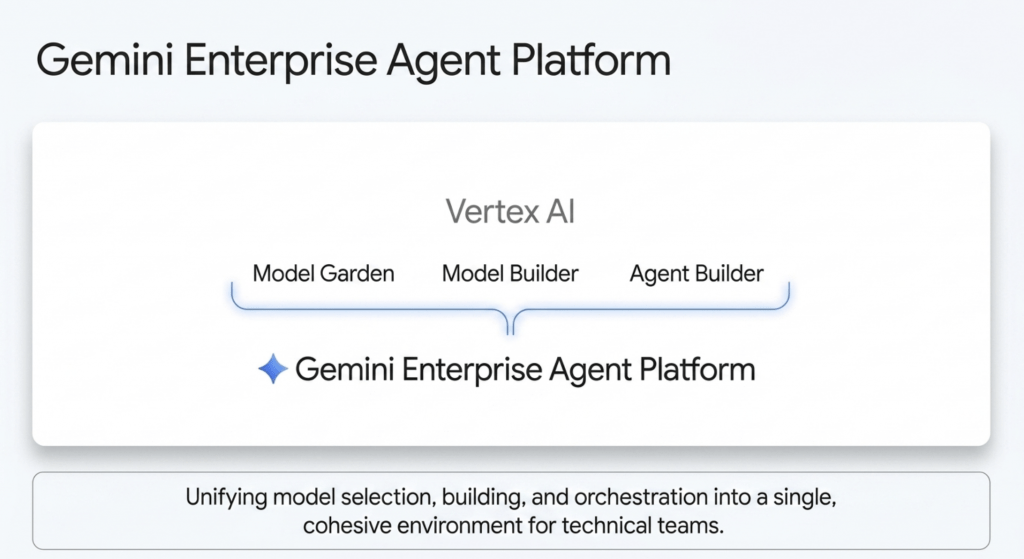
Gemini Enterprise Agent Platform: Representing the evolution of Vertex AI, the Gemini Enterprise Agent Platform is the comprehensive foundation for technical teams. It combines the model selection and building capabilities that developers already rely on with powerful new features for orchestration, security, and DevOps. To directly address the growing need for strict FinOps and cost optimization, Google also introduced proactive cost anomalies detection. A new, dedicated FinOps agent autonomously analyzes spending spikes across your environment and generates highly granular cost reports on demand, ensuring your AI scaling doesn’t lead to unexpected budget overruns.
Gemini Enterprise App: For the everyday workforce, the Gemini Enterprise App serves as the new collaborative “front door” to AI. It is designed to empower non-technical employees to build and manage their own digital assistants.
- Agent Designer: This no-code visual builder allows business users to create sophisticated, multi-system workflows using simple natural language. Employees can now build agents that trigger automatically based on specific events or run on a set schedule without writing a single line of code.
- Inbox in Gemini Enterprise: As employees deploy more long-running agents to handle tasks like financial reconciliation or sales sequencing, they need a way to track them. The new Inbox acts as a unified hub to monitor active workflows, adjust configurations, and receive real-time status alerts, ensuring automated processes always stay on track.
- Projects: To solve the problem of context loss, Projects creates a persistent, data-grounded knowledge base for your team. It serves as a secure “shared brain” that grounds the AI strictly in explicitly added files and conversations. This ensures that critical project intelligence remains a permanent company asset, providing true operational continuity even as team members change roles.
Gemini Enterprise for Customer Experience (CX) Designed to seamlessly unify the shopping and service journey, this suite ensures a frictionless customer experience from product discovery to post-sale support.
- CX Agent Studio: A low-code visual builder that allows teams to design empathetic, highly multimodal agents grounded entirely in your enterprise data.
- Omnichannel Gateway: This guarantees that a customer’s context travels flawlessly across web, mobile, voice, and social channels without any lag or repetition. The return on investment here is already proven; for example, Best Buy utilized these tools to increase their customer self-service rates by a staggering 200% by having agents engage in precise, long-format troubleshooting.
Google Workspace: Reimagining Enterprise Productivity
For the billions of users relying on Google Workspace, AI is transforming the suite from a collection of static applications into a dynamic, interconnected ecosystem.
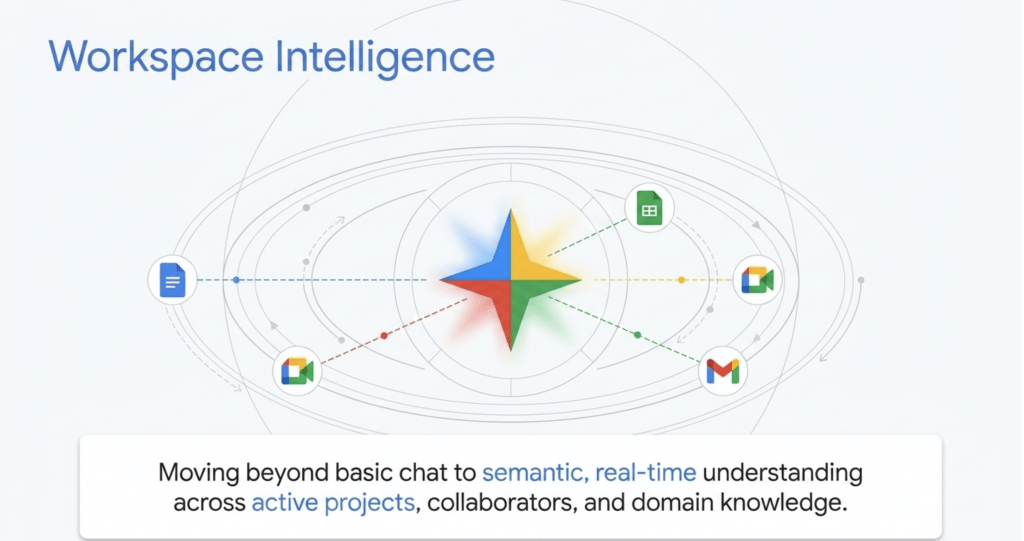
Workspace Intelligence: The cornerstone of this transformation is Workspace Intelligence, a new, unified semantic layer. Instead of forcing users to manually copy and paste context into every single prompt, Workspace Intelligence inherently understands the complex relationships within your specific work ecosystem. It securely maps your active projects, your frequent collaborators, and the domain knowledge living across Docs, Slides, and Gmail. This allows the AI to do the heavy lifting of gathering context across silos, safely providing personalized, highly relevant outputs.
New AI Features in Google Workspace
- Ask Gemini in Google Chat: Your Chat window is now a unified command line for all of your work. It provides a daily briefing that surfaces important tasks and unread threads. Crucially, with expanded third-party connectors (like Asana, Jira, and Salesforce), Ask Gemini bridges the gap between your Workspace content and external tools, allowing you to find information across your entire tech stack without leaving the conversation.
- Docs: Gemini can now automatically generate infographics, edit multiple images simultaneously, and automatically triage or edit documents based on user comments.
- Slides: You can now generate full, editable presentation decks in one shot, with the AI strictly adhering to your company’s official templates and styles.
- Sheets: A new Interactive Canvas allows you to use natural language to build interactive mini-apps—like kanban boards and custom dashboards—directly on top of your live data.
- Drive: Drive Insights and Projects centrally organize files to give Gemini full context, allowing you to instantly extract insights across your entire drive using AI Overviews.
- Vids: You can now quickly convert presentations into videos featuring highly realistic, fully branded AI avatars, complete with custom company logos and backdrops.
- Workspace MCP Server: Currently in public preview, the Workspace Model Context Protocol (MCP) Server allows developers to safely bring advanced Workspace capabilities—like synthesizing Drive documents or drafting Gmail responses—directly into their own custom AI applications and agents using a secure, open framework.
- Rapid Enterprise Migration: For organizations looking to move away from legacy tools, migrating your entire organization from Microsoft 365 to Google Workspace is now up to five times faster. This is powered by a new cloud-based data import service built directly into the admin console. To ensure there is no friction when collaborating with external partners still using Office, Google has also added improved interoperability features like an AI-powered Office macro converter, native Office file editing in Gmail, and redlining in Docs.
Agentic Defense: Securing the Autonomous Frontier
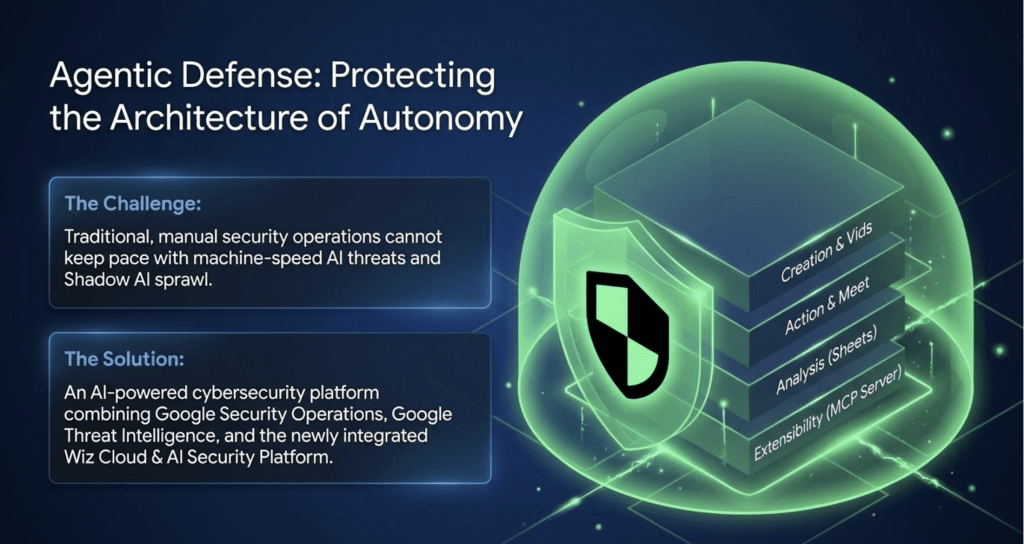
As AI accelerates business operations, it simultaneously accelerates the speed of malicious actors. At Next ’26, Google revealed that adversaries have reduced the time it takes to move from initial access to a threat hand-off from eight hours down to a terrifying 22 seconds. To combat this, human defenders require AI that operates at machine speed.
Wiz AI-Application Protection Following its deep integration into the Google Cloud ecosystem, Wiz introduced a comprehensive suite to secure the entire AI development lifecycle. A standout capability is the AI-Bill of Materials (AI-BOM). This dynamic tool automatically inventories all AI frameworks, language models, and IDE extensions across your multicloud environment. It provides absolute visibility into what is writing code in your stack, tracking sanctioned tools while aggressively uncovering and flagging unapproved “shadow AI” plugins. Furthermore, Wiz now offers inline security scanning that natively protects vibe-coded applications, surfacing vulnerabilities before they ever reach production.
Securing Agents and the Agentic Web: To ensure that autonomous agents operate within strict, governed boundaries, Google introduced several foundational security layers. Agent Identity provides every digital worker with a unique cryptographic identity, allowing for precise, scoped human delegation and access management. Agent Gateway acts as a centralized air-traffic controller, enforcing strict security policies across all agent-to-agent and agent-to-tool communications. Finally, Model Armor integrates directly with Agent Gateway to provide robust runtime protection against emerging threats like prompt injections and sensitive data leakage.
Agentic Threat Intelligence: To shift security from reactive to proactive, Google Security Operations introduced three new specialized, autonomous defenders.
Google Cloud Fraud Defense: As commerce becomes increasingly automated, identifying who—or what—is interacting with your systems is paramount. In a major evolution of reCAPTCHA, Google launched Fraud Defense. This unified trust platform is explicitly engineered for the agentic web, capable of discerning the subtle differences between human users, malicious botnets, and authorized, helpful AI agents, effectively securing the digital journey from registration through to final payment.
The Agentic Data Cloud: Fueling Autonomous Action
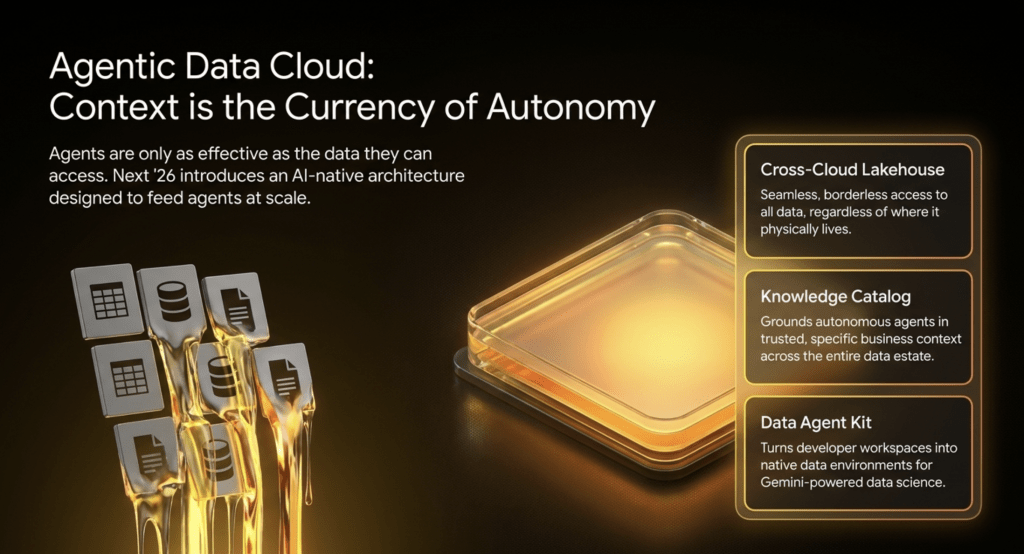
In the agentic era, an AI agent is only as smart as the data it understands. Google’s Agentic Data Cloud unifies your operational databases, analytical lakehouses, and AI models so your digital taskforce is grounded in absolute enterprise truth—without causing cloud costs to spiral.
Here are the core upgrades:
- Knowledge Catalog (Governance): This replaces static data dictionaries with a dynamic, universal context engine. It autonomously maps your business logic and permissions without moving a single byte of data, ensuring agents execute tasks accurately based on your company’s unique lingo.
- Cross-Cloud Lakehouse (Migration): Standardized on open Apache Iceberg, this allows you to instantly query data across Google Cloud, AWS, and Azure. It provides zero-copy, zero-ETL access, completely eliminating the latency and massive egress fees normally associated with cross-cloud data.
- BigQuery Fluid Scaling (FinOps): Built for unpredictable agentic workloads, BigQuery now adapts dynamically with true per-second billing and zero minimums. This structural change delivers up to 34% in immediate cost savings for enterprise FinOps teams.
- The Data Agent Kit: This shifts data engineering teams away from writing manual pipelines and toward agent orchestration. It turns any developer workspace into a native data environment to autonomously generate production-ready code.
- Conversational BI with Looker: Looker introduces Dashboard Agents that allow everyday users to ask natural language questions directly within their dashboards, delivering answers that are strictly governed by your enterprise semantic layer.
- AlloyDB AI at Massive Scale: To support the performance demands of enterprise AI, AlloyDB AI now scales to support over 10 billion vectors. It can process 100,000 rows per second for less than a tenth of a cent, bringing unprecedented cost-efficiency to operational databases.
Conclusion
Google Cloud Next 2026 proved that the infrastructure, intelligence, and security layers required for enterprise-grade AI are now fully integrated. By combining the unified context of Workspace Intelligence, the orchestration power of the Gemini Enterprise Agent Platform, and the machine-speed protection of Agentic Defense, Google Cloud has provided mature organizations with the exact tools they need to safely modernize their legacy systems, optimize their FinOps, and unleash the true ROI of artificial intelligence.